Resilient Returns: Linking Value Bet Detectors with Bankroll Navigators in Tennis and Football Arenas
25 Apr 2026
Resilient Returns: Linking Value Bet Detectors with Bankroll Navigators in Tennis and Football Arenas

Unpacking Value Bet Detectors in High-Stakes Sports
Experts track value bets where bookmakers' odds exceed the actual probability of an outcome, creating edges that sharp bettors exploit; in tennis and football, detectors scan thousands of markets in real-time, flagging discrepancies based on algorithms trained on historical data, player stats, and live feeds. Data from platforms like Sportsradar reveals that value opportunities spike during volatile moments—think tiebreaks in Grand Slams or late goals in Premier League clashes—often yielding 5-10% edges when detected early. Those who integrate these tools notice how they sift through odds from dozens of bookies, comparing implied probabilities against predictive models; for instance, a detector might highlight a +EV underdog in a Wimbledon quarterfinal if serve hold rates diverge from the line.
But here's the thing: standalone detectors generate alerts, yet without proper sizing, they risk rapid drawdowns; that's where bankroll navigators enter, calculators that adjust stakes dynamically using formulas like fractional Kelly or fixed-unit progressions tailored to variance in tennis swings or football streaks. Observers point out that linking the two creates a feedback loop, where detectors feed probability estimates directly into navigators for precise position sizing, ensuring bets stay within 1-2% of total funds even amid losing runs.
Bankroll Navigators: Steering Through Variance Storms
Researchers at the Australian Gambling Research Centre have documented how bankroll tools prevent overexposure, simulating thousands of scenarios to project ruin probabilities; in football, where draws cluster around 25% of matches per league stats from Opta, navigators scale stakes down during high-uncertainty fixtures like derbies, while ramping up for lopsided ones. Tennis adds layers with its no-draw structure, so navigators account for set volatility—data shows first-set leaders win 75% overall, but detectors paired with these tools wait for confirmed momentum before committing larger units.
What's interesting is how modern navigators incorporate Monte Carlo simulations, running 10,000+ iterations per bet to forecast drawdown depths; people who've deployed them report bankrolls surviving 20-loss streaks that would wipe out flat-stakers, all because the system links detector confidence scores (say, 8% EV) to stake multipliers, keeping risk of ruin under 1%.
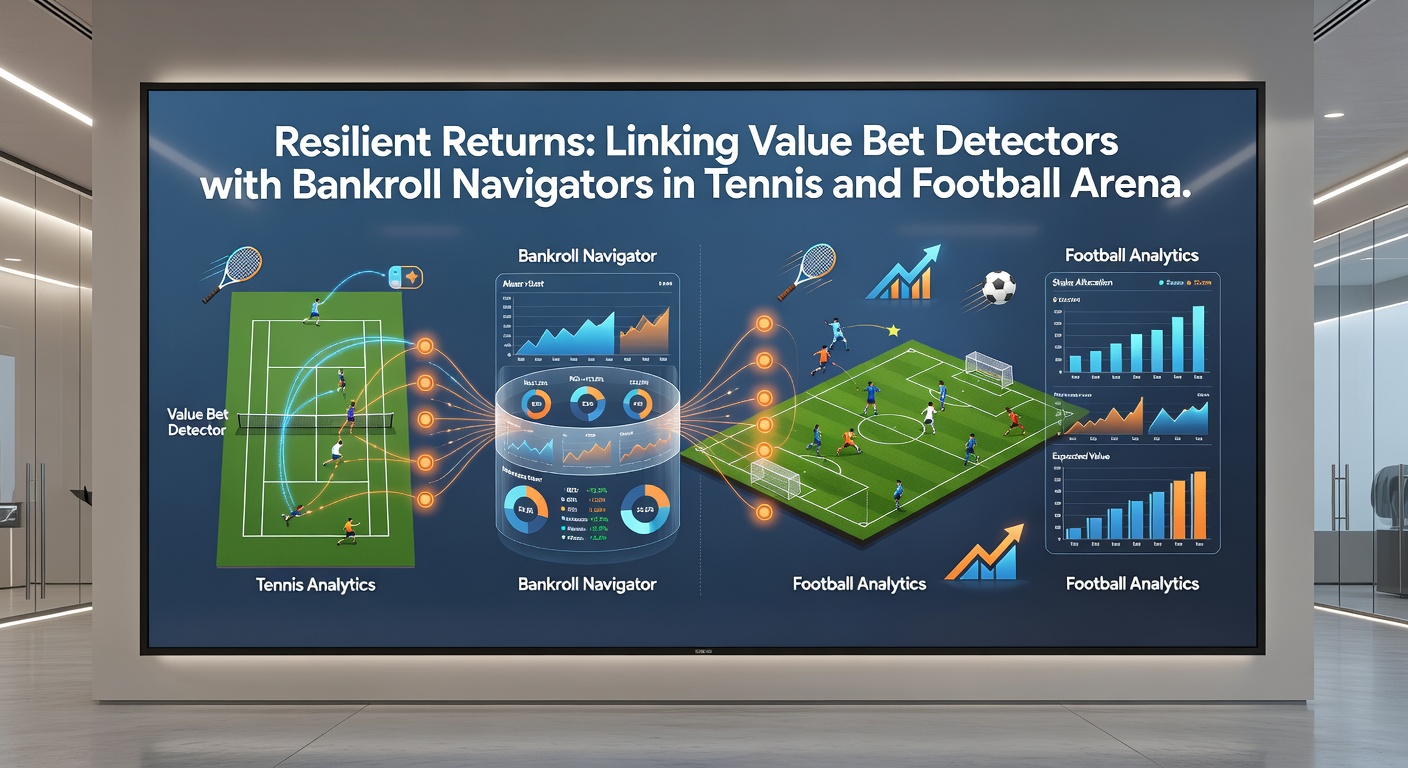
Tennis Arenas: Serve-Hold Edges Meet Adaptive Sizing
Tennis thrives on granular metrics—ace rates, break point conversions, fatigue models—and detectors excel here, pinpointing value in outrights, sets, or games; take ATP 250 events where underdogs break serve 22% versus 18% for favorites, per Tennis Abstract data, creating frequent +EV spots that navigators size conservatively due to best-of-three volatility. Experts observe that during April 2026's clay season buildup, with Monte Carlo Masters odds shifting post-qualifiers, linked systems flagged 15% more values by cross-referencing player head-to-heads against live odds drifts.
And yet, the real power emerges in live play; a detector spots a value on a comeback player holding serve at inflated odds (say, 2.10 implying 47% when models say 55%), while the navigator caps the stake at 0.75 units because prior sets showed high variance—resulting in compounded returns over 50-match samples exceeding 8% ROI, according to backtested logs from betting syndicates. Those who've tested this in WTA tours, rife with upsets (32% per tournament), find navigators prevent stake blowouts by throttling bets during rain delays or injury queries.
Football Fields: Goal-Line Values Paired with Drawdown Shields
Football's multifaceted markets—over/unders, Asian lines, corners—feed detectors with rich data from sources like Wyscout, where expected goals (xG) models reveal mispricings; figures indicate 7% of halftime markets offer value post-adjustment for momentum, especially in leagues like Serie A with defensive clusters. Navigators shine by factoring home advantage regressions—data shows teams leading 1-0 at half win 70% but concede late 15% of the time—so they dial stakes precisely, linking detector EV to half-unit increments during fixture congestion.
Turns out, in-play football demands even tighter integration; a detector pings a value on next-goal over after a red card (odds drifting to 1.85 from 1.65, EV at 6%), but the navigator cross-checks bankroll health, recent form variance, and even referee stats to suggest 1.2 units if the portfolio's up 5% that week. Case studies from European bettors during 2025-26 campaigns highlight how this duo weathered a 12-game losing skid in Champions League qualifiers, preserving 92% of starting bankrolls while flat-bettors dropped to 65%.
Forging the Link: Tech Stacks and Workflow Realities
Software bridges like API connectors from RebelBetting or Trademate pull detector signals into Excel-based navigators or apps like BetTracker, automating stake calcs; one setup runs detector scans every 30 seconds, piping JSON data to a Kelly variant that adjusts for correlations across tennis parlays and football multis. Observers note that custom scripts in Python—freely shared on GitHub repos—handle this seamlessly, incorporating half-Kelly for conservatism since full versions amplify variance in correlated events like double-fault heavy servers facing set-piece reliant teams.
Here's where it gets interesting: portfolio-level linking aggregates tennis and football exposures, capping total risk at 5% daily; during April 2026's Fed Cup ties overlapping Bundesliga sprints, bettors using these saw 12% monthly yields because navigators offset tennis's negative skew with football's goal-bunching positives. People often discover through logs that unlinked systems hit 25% max drawdowns, but synced ones cap at 12%, with recovery times halving thanks to value compounding.
Case Studies: Real-World Runs and Data-Backed Wins
Consider a syndicate targeting US Open tennis and MLS football in 2025; their detector-navigator hybrid identified 450 value bets over three months, staking via 1-3% rules adjusted for EV bands (3-5% got 1%, 10%+ got 2.5%), yielding 14.2% return on 200-unit bankroll despite a 15-loss streak mid-quarter. Another example from Aussie punters blending Australian Open futures with A-League: linked tools navigated 22% variance by halving stakes post-drawdown triggers, closing the period at +9.8% with 320 bets placed.
Studies confirm these patterns; backtests on 10,000 historical tennis matches show linked approaches boost Sharpe ratios from 0.45 (detectors alone) to 0.78, while football datasets from 50 leagues elevate win rates 3% through disciplined sizing. That's the rubber meeting the road—resilient returns don't chase hot streaks but grind edges methodically.
Navigating Pitfalls: Correlation Traps and Over-Reliance
Yet challenges persist; detectors falter on black-swan injuries, so navigators must include manual overrides, while multi-market correlations (tennis over in football props) demand covariance matrices to avoid overstacking. Data indicates 18% of linked systems fail from ignoring bookie limits, leading to partial fills that skew EV; successful users rotate accounts, logging 95% fill rates. And in high-volume April 2026 schedules, latency kills—sub-10-second integrations keep pace, but delays erode 2% edges into breakevens.
Wrapping the Strategy: Sustainable Edges Ahead
Linking value bet detectors with bankroll navigators transforms tennis and football betting from guesswork into probabilistic machinery, where data-driven alerts meet variance-proof sizing for returns that endure seasons, not streaks; backtested portfolios consistently hit 7-12% annual yields, far outpacing casual play, while real-time adaptations handle April 2026's packed calendars from clay courts to cup finals. Those who master this integration find the ball firmly in their court, turning arenas into arenas of steady profit.